Automatic Circulation Valve
The Automatic Recirculation Valve (ARC) is a specialized device designed to protect centrifugal pumps under low-flow conditions. It prevents pump damage and cavitation by ensuring a minimum flow is always maintained.
Explanation
The Automatic Recirculation Valve (ARC) is a specialized device designed to protect centrifugal pumps under low-flow conditions. It prevents pump damage and cavitation by ensuring a minimum flow is always maintained.
ARC valves are commonly used in systems that transfer fluids such as boiler feedwater, condensate, or process liquids.
Key Advantages
- Advanced Process Control
- Low-Flow Protection
- Enhanced System Reliability
- Compact Design
Typical Applications
- Oil & gas industry
- Chemical industry
- Petrochemical industry
- Power generation
- Technical gases
Technical Information
| Article | CE (Metric) | ASME (SI) | ||
| Inlet Size Range | DN 50-DN 300 | 2″-12″ | ||
| Outlet Size Range | DN 50-DN 300 | 2″-12″ | ||
| Connection Std | EN 1092-1 | ASME B16.5 | ||
| Inlet flange rating | PN 20-PN 420 | CL 150-CL 2500 | ||
| Pressure range | 0.3 up to 350 Bar | 5 up to 5076.3 psig | ||
| Temperature Range | -100 to 550 °C | -148 to 1000 °F | ||
| Body Material | ||||
| Carbon Steel | 1.0460, 1.0619 | Carbon Steel | SA 105, SA 216(WCB), SA 352(LCB) | |
| Heat Resistant Carbon Steel | 1,7357 | Heat Resistant Carbon Steel | SA 217(WC6) | |
| Stainless Steel | 1.4408, 1.4409 | Stainless Steel | SA 351(CF8M, CF3M) | |
| Spring Material | 1.4310, 1.4401, 1.4404, 1.4571, 1.7102, 1.8159, EN 10270, 2.4669 | 302, 316, 316L, 316Ti, Inconel X-750 | ||
| Seat Types | Soft Seat, Hard Seat(Metal to Metal) | |||
| Seat Materials | ||||
| Metal Sealing: Stellite 6 | ||||
| Soft Sealing: NBR, HNBR, Viton, Kalrez | ||||
Standards
| Standard | Title / Description |
| ASME B16.5 | Pipe flanges and flanged fittings |
| ASME B16.34 | Valves – Design parameters for flanged, threaded, and welded ends |
| ASME Section II | Materials and their specifications |
| DIN EN 20273 | Clearance holes for bolts and screws – Fastener components |
| ISO 15156 / NACE MR0175 | Selection of materials resistant to sulfide stress cracking in oilfield environments |
Installation Guidelines
The ARC valve should be installed as close as possible to the discharge port of the centrifugal pump, preferably mounted directly on the pump’s discharge outlet. The distance between the pump outlet and the valve inlet must not exceed 3 meters.
Mounting Orientation
- Vertical installation is preferred
- Horizontal installation is available upon request
Kiatork ARC valves operate with low noise levels, ensuring quiet performance in sensitive environments.
Fluid Quality Requirements
- Inlet water must not contain solid particles larger than 0.3 mm
- For commissioning, a particle size of 0.1 mm or smaller is recommended
- Larger particles may damage valve seats
Fonksiyon
Operating Principle
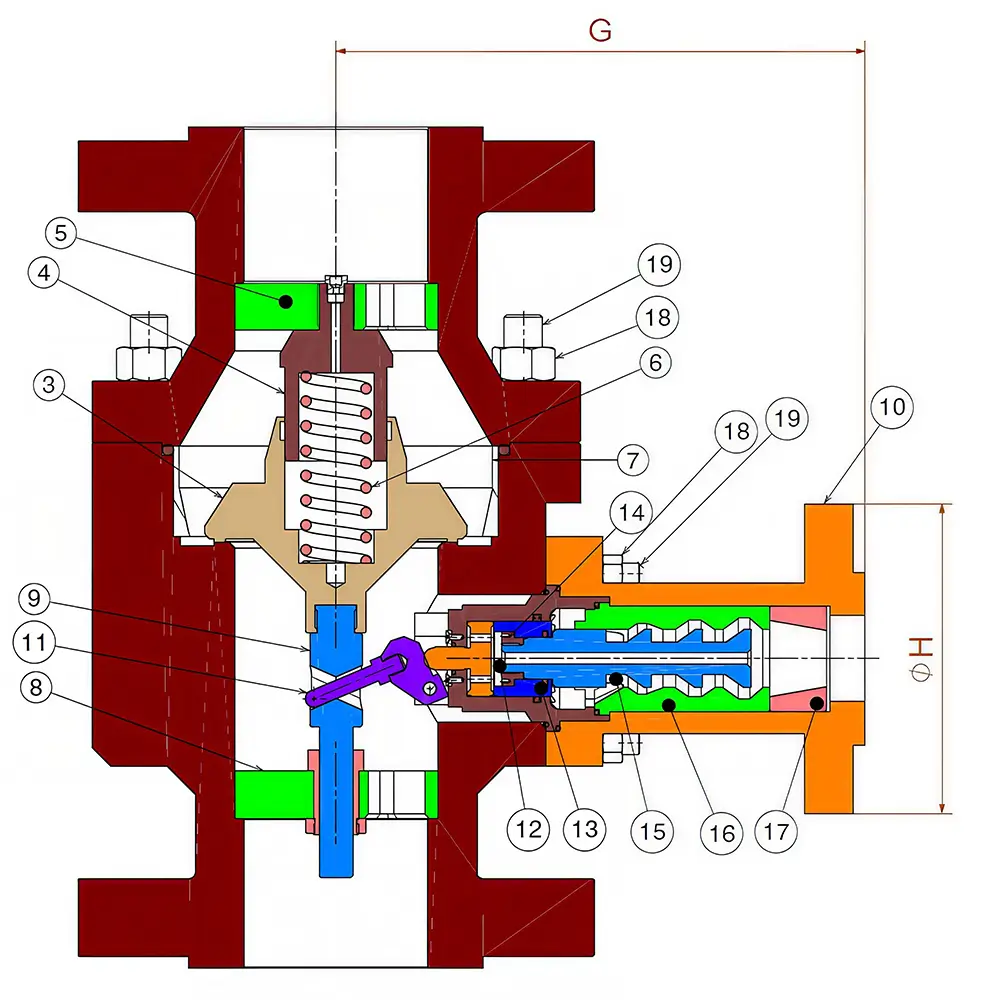
The main outlet flow controls the check valve and positions it proportionally to the flow rate. The check valve stem transmits this movement via a lever to the bypass system. The bypass mechanism modulates the bypass flow and reduces pressure to the bypass outlet level without causing cavitation.
- When the check valve is fully closed, the entire minimum flow is directed through the bypass.
- When the check valve is in a fully open position, the bypass is completely closed, allowing full pump flow to the system.

No Main Flow – Bypass Only
When no product is required by the process, the valve disc returns to its seat. There is insufficient flow to compress the spring and lift the disc.
In this position, the curved section of the hollow body aligns with the bypass cone inlet. A predefined minimum flow is redirected from the pump through the bypass section and returned to the pump inlet. This protects the centrifugal pump from overheating or cavitation.

Full Main Flow – Bypass Closed
Under normal operating conditions, the main line is open. The pressure from the process flow compresses the spring on the check valve disc, lifting it fully from its seat. As the connected disc stem rises, the bypass cone outlet is moved toward the valve body, closing the bypass system. Recirculation is blocked, eliminating energy loss. Thus, the bypass flow is inversely proportional to the main pump flow.

Combined Flow – Partial Main Flow with Bypass
As process demand decreases, the pressure on the disc spring drops, and the disc moves toward its seat. The check valve portion of the ARC valve shifts to a partially open position.In this state, partial flow continues to the outlet while a minimum flow is directed through the bypass. This ensures pump protection during transitional operating conditions.


