How a Safety Relief Valve Works – Step by Step
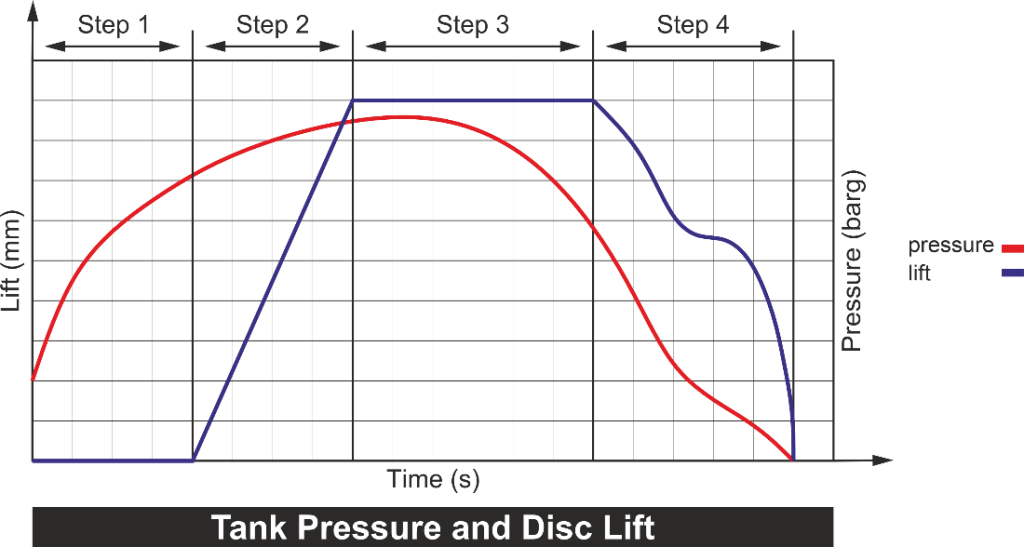
Safety relief valves use spring force to hold the disc in place. Under normal operating pressure, the spring force exceeds the inlet pressure force, keeping the valve closed. The valve opens when the system pressure exceeds the spring force.

Step 1: Valve Closed (Normal Operation)
Condition: Inlet Pressure < Set Pressure
Mechanism:
- System pressure acts on the disc surface (area “A”)
- Spring force resists this pressure
- As system pressure approaches the set pressure, the seating force between the disc and nozzle nears zero
Step 2: Valve Slightly Open (Pre-Opening Phase)
Condition: Inlet Pressure ≥ Set Pressure but < Popping Pressure
Mechanism:
- In vapor or gas service, the valve may slightly open before fully popping
- Fluid begins to move audibly into the accumulation chamber “B”
- Flow restriction between the disc holder and adjusting ring causes pressure buildup in “B”
- This buildup creates an expanding force that helps overcome the spring
- The adjusting ring can be tuned to control pressure accumulation
- Once the accumulated pressure exceeds the spring force, the disc lifts and the valve pops open
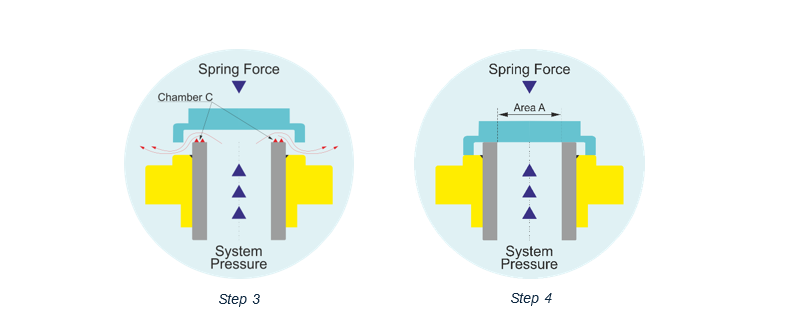
Step 3: Valve Fully Open (Popping Phase)
Condition: Inlet Pressure ≥ Popping Pressure
Mechanism:
- Additional pressure forms at point “C”
- Sudden flow increase through the annular gap between the inner edge of the disc holder skirt and the outer diameter of the adjusting ring
- These forces cause the disc to lift significantly during the pop
Step 4: Valve Reseats (Closing Phase)
Condition: Inlet Pressure drops below reseating pressure
Mechanism:
- When inlet pressure falls sufficiently below the set pressure, the valve closes
- Spring force overcomes the combined forces at points “A”, “B”, and “C”
- The pressure at which the valve reseats is called the reseating pressure
- The difference between the set pressure and reseating pressure is known as blowdown